Van Gogh Museum Amsterdam: The Complete Visitor Guide
Tickets, Sunflowers, the best route and practical tips for the world's largest Van Gogh collection.
Address
Museumplein 6, 1071 DJ Amsterdam
Opening hours
Daily from 9:00, closing 17:00 (check evenings)
Ticket price
Around €25 adults, under 18 free
Best for
Art lovers, couples, families, first-timers
Duration
1.5–2.5 hours
Book Van Gogh Museum Tickets
Choose your date and entry time, then compare standard admission with related experiences. Each listing shows what is included, so you can pick the option that suits your visit.
Why Book in Advance
The Van Gogh Museum uses timed entry to keep the galleries comfortable, and popular slots can sell out, particularly at weekends and in school holidays. Spring and summer are the busiest seasons, so choosing your time ahead of arrival avoids disappointment. Booking early also makes it easier to plan the rest of your day around a confirmed slot, including a second museum nearby.
What is the Van Gogh Museum, and why visit?
The Van Gogh Museum, on Museumplein in Amsterdam, holds the world's largest collection of Vincent van Gogh's paintings, drawings and letters. Visit to see Sunflowers, The Bedroom and Almond Blossom, and to follow his life and work in order, from the Netherlands to France.
Why Visit the Van Gogh Museum?
Vincent van Gogh is one of the most recognised artists in history, yet most people only know a handful of his images. The Van Gogh Museum changes that. With around 200 paintings, 500 drawings and hundreds of letters, it holds the largest collection of his work anywhere, and it presents it as a story rather than a list of famous pictures.
The collection is unique because it comes from the family. Vincent's brother Theo kept his work and his letters, and Theo's family later preserved them. In 1973 the family's heirs established the museum, so the objects here were never sold into private hands. That gives the museum a depth of context, from early sketches to late canvases, that no other institution can match.
Among Amsterdam's highlights, this is the most emotionally direct. The Rijksmuseum offers scale and grandeur, while the Van Gogh Museum offers intimacy. You learn how a man who started painting at 27 changed art in a decade, and you see the brushwork up close. For a first visit to Amsterdam it is a perfect companion to the nearby Rijksmuseum.
A Short History of Vincent van Gogh
Early Life
Vincent Willem van Gogh was born on 30 March 1853 in Zundert, in the south of the Netherlands, the eldest son of a Protestant minister. He worked for an art dealing firm, taught briefly in England and spent time as a lay preacher in a Belgian mining area. Those experiences left him with a lasting sympathy for working people, and in 1880 he decided to become an artist.
Artistic Development
He was largely self-taught and learned by copying prints, studying drawing manuals and working relentlessly. His early Dutch period is dark and earthy, culminating in The Potato Eaters of 1885, a deliberately rough portrait of peasants at a meal. He studied at the academy in Antwerp, where he discovered Japanese woodblock prints and the power of colour, and in 1886 he moved to Paris to join his brother Theo, an art dealer.
Paris and the South of France
In Paris he met Impressionists and Post-Impressionists, including Toulouse-Lautrec, Gauguin and Bernard. His palette brightened and his brushwork became more expressive. In February 1888 he moved to Arles in the south of France, hoping to build an artists' community in the Yellow House. In that productive year he painted Sunflowers, The Bedroom and his landscapes of blossoming orchards. Paul Gauguin joined him that autumn, but their relationship ended in crisis and Vincent's breakdown in December 1888.
He spent time in the asylum at Saint-Rémy, where he painted swirling skies and cypresses, and in May 1890 he moved to Auvers-sur-Oise near Paris. In those last ten weeks he completed dozens of works. He died on 29 July 1890, two days after shooting himself, at the age of 37.
Legacy
In his lifetime he sold very few paintings. After his death, Theo died in 1891, and Theo's widow, Johanna van Gogh-Bonger, devoted her life to promoting Vincent's work. She published his letters and organised exhibitions, and by the early 20th century his reputation had grown rapidly. His son Vincent Willem later helped found the museum, which opened in 1973 in a building designed by Gerrit Rietveld, with a new wing by Kisho Kurokawa added in 1999.
Why His Art Matters Today
Van Gogh matters because he made feeling visible. His thick paint, vivid colour and directness opened the way for Expressionism and modern art. His letters reveal an honest, thoughtful man who struggled with illness, money and self-doubt but never stopped working. Today he is often seen as a symbol of creative persistence, and the museum helps visitors see him as a person, not only a famous name.
Top Highlights
Sunflowers
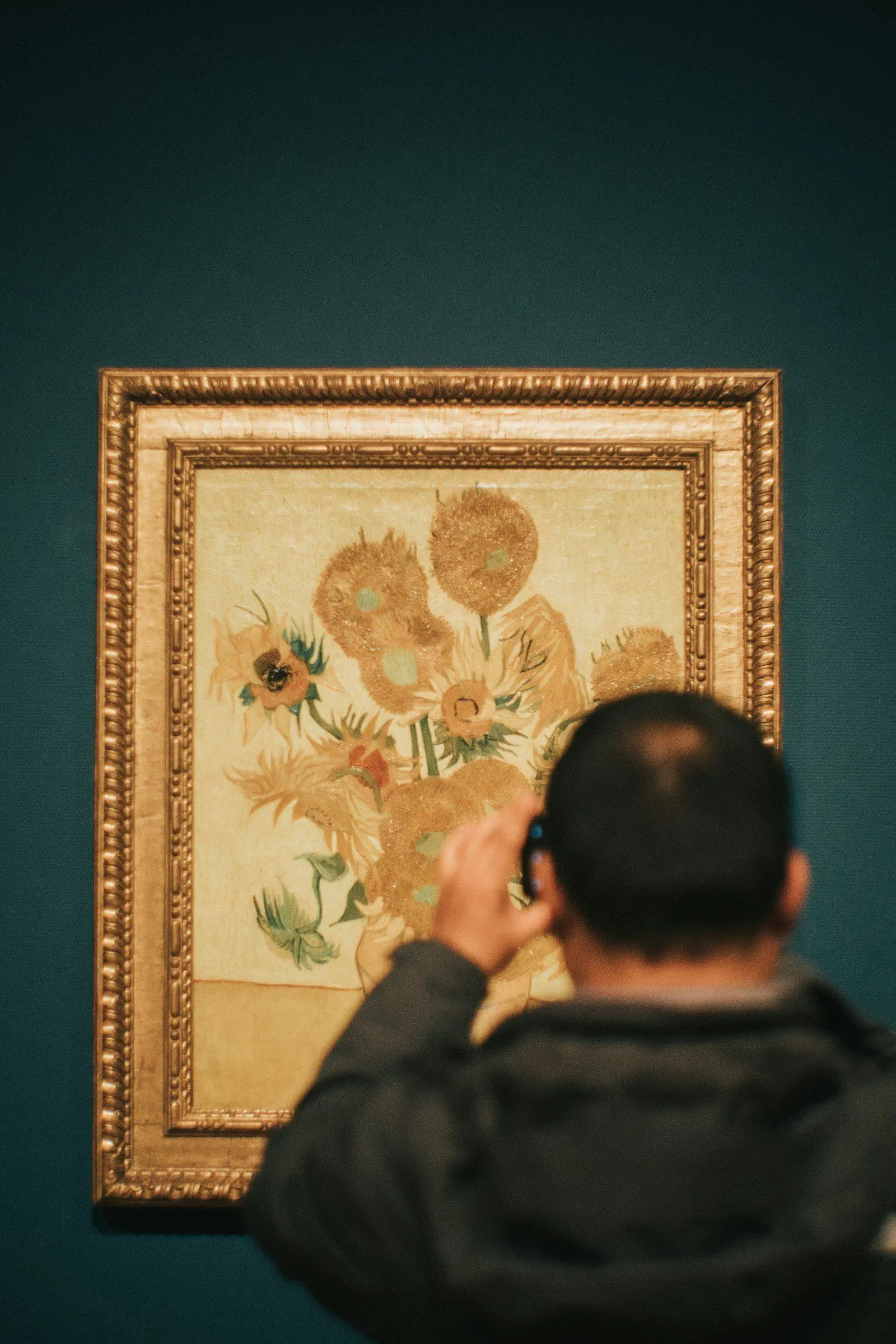
Painted in Arles in 1889 as a version of his earlier series, Sunflowers is the museum's best-known work. The thick yellow paint, the confident stalks and the withering heads show his love of colour and his affection for ordinary things. Vincent painted the series to decorate Gauguin's room in the Yellow House. Look closely at the signature on the vase, and at how many tones of yellow he uses.
Almond Blossom
Almond Blossom was painted in 1890 at Saint-Rémy to celebrate the birth of Theo's son, Vincent Willem. The delicate branches against a turquoise sky are influenced by Japanese prints, and it is among his most peaceful and optimistic paintings. It is a quiet counterpoint to the more turbulent works around it.
The Bedroom
In 1888 Van Gogh painted his bedroom in the Yellow House in Arles, creating a bright, simple space meant to suggest rest. He made three versions, and the museum has one. The tilted perspective and flat colours show his debt to Japanese prints and his search for calm.
Self-Portraits
Van Gogh painted more than thirty self-portraits, mostly in Paris, where he could not afford models. They show him in changing styles, from dark and sombre to bright and dotted, and the museum holds a wide selection. They are the best way to see how his technique developed in only a few years.
Letters to Theo
The letters are the heart of the museum's story. Vincent wrote regularly to Theo, describing his struggles, his ideas about colour and his daily life, often with small sketches. Display cases and the multimedia guide let you read extracts alongside the paintings. They explain why this collection feels so personal.
Temporary Exhibitions
The museum runs changing exhibitions that place Van Gogh in context, or look at related artists and themes. They are often excellent, and they can change the character of a visit. Check the current programme when booking, and allow extra time if an exhibition interests you, as these may require a separate or combined ticket.
What to Expect Inside
The permanent collection is arranged chronologically over several floors, so you follow Van Gogh from his early Dutch years to his final months in France. Beyond the Van Gogh galleries, you will find works by his contemporaries, including Monet, Gauguin and Toulouse-Lautrec, which help you understand his influences. Special exhibitions are in a separate wing.
Best Route
- Begin on the floor that covers his early life and the Dutch period, then follow the story upward.
- Pause at the self-portraits and the Paris galleries.
- Spend the most time with the Arles paintings, including Sunflowers and The Bedroom.
- Finish with the Saint-Rémy and Auvers-sur-Oise works, including Almond Blossom, which closes the story.
- Visit the temporary exhibition if you have time.
How Much Time You Need
Allow 1.5 to 2.5 hours. A fast highlights visit takes about 75 minutes, and a leisurely visit with an audio guide and a coffee takes closer to three.
Most Important Galleries
Focus on the sections for his Paris years and the Arles period, as they contain the best-known works. If you have to choose, skip the supporting galleries on other artists rather than rushing the Arles rooms.
Crowd Expectations
This is a popular museum, and the most famous rooms are often busy. Timed entry keeps numbers manageable, but you should expect to share space with other visitors, especially at midday. Visit early or late to enjoy a quieter experience.
Visitor Information
- Address: Museumplein 6, 1071 DJ Amsterdam.
- Opening hours: Normally daily, from 9:00 to 17:00, with later hours on some evenings. Check the current schedule before you go.
- Admission: Around €25 for adults, free for visitors under 18. Prices may change.
- Photography rules: Photos are generally not allowed in the galleries, so plan to enjoy the paintings in person. Check the signs on arrival.
- Accessibility: Step-free access, lifts to all floors, accessible toilets and wheelchairs available.
- Lockers: Lockers and a cloakroom for coats and bags. Large bags are not allowed in the galleries.
- Food and drink: A café on site and many options on Museumplein. No food or drink in the galleries.
Best Time to Visit
- Morning: The opening hour is the calmest period and gives you the best chance at a clear view of Sunflowers.
- Afternoon: Busier after lunch. The final two hours before closing can be much quieter.
- Weekdays: Calmer than weekends, particularly Tuesday to Thursday.
- Weekends: The busiest days. Book early and choose the first slot of the day.
- Spring: Busy, with tulip-season visitors. Book ahead.
- Summer: The peak. Expect crowds in the main rooms and busy ticket slots.
- Autumn: Pleasant and less crowded, except in school holidays.
- Winter: The quietest season, and a good time for a relaxed visit.
How to Get to the Van Gogh Museum
- From Amsterdam Centraal: Take tram 2 or 12 toward the Museumplein area, around 15–20 minutes, then walk a few minutes.
- From Schiphol Airport: Take a train to Amsterdam Zuid and continue by tram or metro, or travel to Centraal and take a tram. Allow 30–45 minutes in total.
- By tram: Several lines stop within a short walk of Museumplein, including lines 2, 5 and 12. Check a live planner for the current network.
- By metro: The North/South line stops at Vijzelgracht or Zuid, around a 10–15 minute walk.
- By bike: Easy and flat, with bike parking near the museum.
- On foot: About 5 minutes from the Rijksmuseum and 10 minutes from Leidseplein.
Visiting With Children
Suitable ages: The museum suits children of about eight and older best, as they can follow the story of Vincent's life. Younger children can enjoy colourful paintings but may tire sooner.
Family tips: Children under 18 enter free. Ask about the family activities and trails on offer, and set a small challenge, such as finding every painting with a sunflower or a self-portrait. Read one of Vincent's letters aloud to bring him to life. Take a break in the café and finish with a run on the Museumplein lawn.
Suggested duration: About 75 to 90 minutes for most families. Aim for the morning, when children have the most energy.
Cruise Passengers and Short Visits
With limited time, preparation is everything. Book a timed ticket in advance for the earliest slot that works, and arrive ten minutes before it. Go straight to the Arles and Paris floors for Sunflowers, The Bedroom and the self-portraits, and finish at Almond Blossom. A well-planned visit of 75 to 90 minutes covers the essentials. Use a taxi or a tram from the cruise terminal, and keep a generous buffer for the return trip, as traffic and tram delays happen. The same applies to long layovers at Schiphol.
Local Insider Tips
- Book your slot before you travel, because walk-up availability is limited.
- Arrive ten minutes early to clear security without stress.
- Go to the top and work your way through the story in order, as the museum intends.
- Use the multimedia guide for context on key paintings, and bring headphones.
- Leave coats and bags in the lockers, which makes the galleries more comfortable.
- Look closely at the paint. Thick strokes and visible brushwork are best seen from a few steps away and then up close.
- Read the letters. They are the best way to feel connected to Vincent.
- Do not rush Sunflowers. Step back, wait for a gap, and return later if needed.
- Visit the museum shop at the end, as the prints and books make good, lightweight souvenirs.
- Split museum days. If you plan both the Van Gogh Museum and the Rijksmuseum, keep a long lunch break in between.
- Check the temporary exhibition before you buy, as it may influence your time slot.
- Wear comfortable shoes and keep a layer, as galleries can feel cool.
Choosing the Right Ticket
- Standard entry: The right choice for most visitors. It gives you timed access to the permanent collection and the current exhibition, according to the museum's rules.
- Audio guide: A good addition for first-time visitors who want context, or for anyone who enjoys learning about the paintings as they walk.
- Guided experiences: Helpful if you prefer expert commentary or have little time. Read each listing to see whether admission is included.
- Combination tickets: Bundles with a canal cruise or another attraction can simplify a busy day. Check that the parts suit your schedule.
- Museum cards: The Museumkaart and the I amsterdam City Card can save money if you visit several museums. You may still need to reserve a time slot.
Compare the options in the ticket section above before you pay. Each listing shows what is included.
Nearby Attractions
- Rijksmuseum: the national museum, with The Night Watch, five minutes away.
- Moco Museum: modern and street art, right beside the Van Gogh Museum.
- Stedelijk Museum: modern art and design on Museumplein.
- Museumplein: the open lawn in front of the museums, ideal for a picnic or a rest, with a pond in summer and an ice rink in winter.
- Canal cruise: a relaxing way to see the city after a museum.
- Vondelpark: Amsterdam's main park, about ten minutes away on foot.
You can also explore the Anne Frank House and the NEMO Science Museum, browse our Amsterdam museums guide, or read the Amsterdam travel guide.
Suggested Itineraries
Half-Day
9:00 Van Gogh Museum highlights. 11:30 coffee on Museumplein. 12:30 stroll through Vondelpark.
Full-Day
9:00 Van Gogh Museum. 12:00 lunch near Museumplein. 13:30 Rijksmuseum highlights. 16:30 Vondelpark. 19:00 dinner in De Pijp.
Museum Day
9:00 Van Gogh Museum. 11:30 Moco Museum for a lighter contrast. 13:00 lunch. 14:30 Rijksmuseum or Stedelijk Museum. Book every slot in advance.
First-Time Visitor
Morning at the Van Gogh Museum, an afternoon canal cruise and an evening walk through the Jordaan. Our 3-day Amsterdam plan shows how to fit it in.
Weekend Visitor
Saturday: Van Gogh Museum at opening, lunch, canal cruise. Sunday: Rijksmuseum, a picnic in Vondelpark and a market visit.
Van Gogh Museum FAQ
How long do you need at the Van Gogh Museum?
Plan 1.5 to 2.5 hours. A focused highlights visit can take about 75 minutes, while art lovers who read the letters and explore the temporary exhibition may stay closer to three hours.
Is the Van Gogh Museum worth visiting?
Yes. It holds the world's largest collection of Van Gogh's work, arranged chronologically so you follow his life as well as his art. Even visitors with little interest in art often find it moving.
What are the most famous paintings at the Van Gogh Museum?
The best known are Sunflowers, The Bedroom, Almond Blossom, The Potato Eaters and several self-portraits. The museum also holds the Yellow House period works and late paintings from Saint-Rémy and Auvers-sur-Oise.
Can you see Sunflowers at the Van Gogh Museum?
Yes. The museum owns one of the famous Sunflowers paintings, dated 1889. Works can be rotated or lent for conservation or exhibitions, so check the museum's current information if it is the main reason for your visit.
How much are Van Gogh Museum tickets?
Adult admission has recently been around €25, and visitors under 18 enter free. Prices can change, so confirm the current price when you book.
Do Van Gogh Museum tickets sell out?
Yes. It is one of the most visited museums in the Netherlands, and popular time slots can sell out days or weeks ahead, particularly in spring and summer and in school holidays.
Is photography allowed at the Van Gogh Museum?
Photography rules are strict. Taking photos in the exhibition galleries is generally not allowed, though some areas of the building may be open to photography. Check the signs and the museum's current rules on arrival.
Is the Van Gogh Museum wheelchair accessible?
Yes. The museum has step-free access, lifts between floors and accessible toilets, and wheelchairs are available. Contact the museum in advance if you need specific assistance.
What is the best time to visit the Van Gogh Museum?
Weekday mornings right at opening, or late afternoon in the last two hours, are usually the calmest. Winter is quietest and July and August are the busiest.
Can children visit the Van Gogh Museum?
Yes. Children under 18 enter free, and the museum offers family activities. It suits children of about 8 and older best, and younger children enjoy a shorter visit of around an hour.
Can I buy tickets at the door?
Tickets are normally sold for a timed slot online, and walk-up availability is limited or not offered. Booking ahead is the reliable way to get in.
What is the Van Gogh Museum's address?
Museumplein 6, 1071 DJ Amsterdam. The museum faces the open lawn of Museumplein, next to the Stedelijk Museum and a short walk from the Rijksmuseum.
What are the opening hours?
The museum is normally open every day from 9:00 to 17:00, with later hours on some evenings. Check the current schedule before your visit.
Is there an audio guide?
Yes. The museum offers a multimedia guide, and many visitors find it a helpful way to follow the story of Van Gogh's life and the details of the paintings.
Can I use the Museumkaart or I amsterdam City Card?
Both are valid for entry, but you should still reserve a time slot in advance. Check the current rules of each pass.
Are there lockers and a cloakroom?
Yes. Coats, bags and umbrellas can be stored in lockers or the cloakroom, and large bags may not be taken into the galleries.
Is there a café or food inside?
Yes. There is a café and a museum shop on site, and Museumplein has more places to eat just outside. Food and drink are not allowed in the galleries.
Can I visit the Van Gogh Museum and the Rijksmuseum on the same day?
Yes, they are about a five-minute walk apart. Most visitors do one in the morning and the other in the afternoon, with a lunch break between them.
How do I get to the Van Gogh Museum from Schiphol?
Take a train to Amsterdam Zuid and continue by tram or metro, or ride to Centraal and take a tram. The total journey is about 30 to 45 minutes.
Which Van Gogh works are not in Amsterdam?
Many famous works, such as Starry Night, are in other collections around the world. Amsterdam is the best place to follow his whole career and to read his letters.
Is the Van Gogh Museum good for a short visit or a cruise day?
Yes, if you book a timed ticket in advance. Follow the highlights route in this guide and allow around 75 to 90 minutes, plus a safe buffer for returning to the port or airport.
Free Amsterdam Insider Guide
Get our free Amsterdam guide with museum tips, hidden spots and seasonal events straight to your inbox.
Free Weekly Newsletter
Stay in the Loop on Amsterdam
Weekly events updates, travel tips, festival announcements, seasonal guides and day trip inspiration — delivered straight to your inbox.
- ✓ Weekly events updates
- ✓ Amsterdam travel tips
- ✓ Festival announcements
- ✓ Seasonal guides
- ✓ Day trip inspiration
🔒 Spam-beschermd. Uitschrijven altijd mogelijk.
Final Verdict
The Van Gogh Museum is a must for almost every visitor to Amsterdam. It is compact, moving and beautifully arranged, and it tells the story of one of the world's most loved artists through his own paintings and words. We strongly recommend it, and we recommend booking a timed ticket in advance.
Who should visit: first-time visitors, art lovers, couples, families with older children, and anyone curious about Vincent's story.
Who may skip: visitors who dislike crowds and have no flexibility on timing, or those who prefer classical art and could choose the Rijksmuseum alone.
Overall rating: 9.4 / 10