Rembrandt House Museum Amsterdam: The Complete Visitor Guide
Tickets, Rembrandt's studio, etching demonstrations and practical tips for the home where the master lived and worked.
Address
Jodenbreestraat 4, 1011 NK Amsterdam
Opening hours
Daily, from morning to early evening (check current hours)
Ticket price
Typically mid-teens to around €20
Best for
Art lovers, history fans, couples
Duration
1–1.5 hours
Book Rembrandt House Museum Tickets
Choose your date and entry time, then compare standard admission with related options. Each listing shows what is included, so you can pick what suits your visit.
Why Book in Advance
The Rembrandt House is a small museum in a historic building, so it uses timed entry to keep the rooms comfortable. It is a popular stop, and weekend slots can fill up. Booking online lets you pick the time you want and usually means faster admission than queuing at the door. It also helps you fit the visit around nearby stops such as Waterlooplein and the Rijksmuseum.
What is the Rembrandt House Museum, and is it worth visiting?
The Rembrandt House Museum is the restored Amsterdam house where Rembrandt lived and worked from 1639 to 1658, with his studio, period rooms and etchings. It is worth visiting for a personal look at the artist's life, and it takes only about an hour.
Why Visit the Rembrandt House Museum?
Most museums show you an artist's finished work. The Rembrandt House shows you where it came from. This is the house where Rembrandt van Rijn lived for almost twenty years, the place where he raised his son, lost his wife, painted some of his most famous works and eventually lost almost everything. Walking through the rooms is a rare chance to stand in the space where an artist actually worked.
The workshop is the highlight. You can see the studio where he painted and taught pupils, and the rooms where he received clients and kept a remarkable collection of curiosities. The interiors have been restored using an inventory made in 1656, so the furnishings are closely based on what the house contained when he lived there.
The museum also sits in the historic heart of Amsterdam, on the edge of the old Jewish quarter. A visit here gives you a vivid sense of life in the Golden Age city, beyond the grand canal mansions and the great museums. It is one of the most personal and atmospheric museums in the city, and its small scale makes it easy to enjoy even if you are short of time.
Rembrandt's Story
Early Life
Rembrandt Harmenszoon van Rijn was born on 15 July 1606 in Leiden, the son of a miller. He was sent to Latin school and enrolled briefly at the university, but he soon left to pursue painting. He trained first in Leiden and then spent a short time in Amsterdam with the history painter Pieter Lastman, who inspired his interest in dramatic stories and expressive faces. By his early twenties he had set up his own studio in Leiden, where he painted small, intense works and produced his first etchings. He began to draw attention for his skill in light and emotion.
Success in Amsterdam
Around 1631 Rembrandt moved to Amsterdam, then one of the richest cities in the world. He worked with the art dealer Hendrick Uylenburgh, whose workshop produced portraits for wealthy merchants. His reputation soared after The Anatomy Lesson of Dr Nicolaes Tulp in 1632, a group portrait that showed a surgeon dissecting an arm before an attentive audience. In 1634 he married Saskia van Uylenburgh, Hendrick's cousin, and the couple became part of Amsterdam's prosperous society. Commissions flowed in, and pupils came to learn from him.
The Night Watch
In 1639 Rembrandt bought the large house on the Sint Antoniesbreestraat, now Jodenbreestraat. Three years later, in 1642, he completed his largest and most famous painting, The Night Watch. It portrays a militia company led by Captain Frans Banninck Cocq, in a dynamic composition full of movement and light. It was not the end of his career, as some legends say, but it remains the high point of his public fame. It hangs today in the Rijksmuseum. The same year brought personal tragedy, as Saskia died, leaving him with their young son Titus.
Financial Difficulties
Rembrandt was extravagant. He collected art, prints and curiosities on a large scale and spent heavily on the house. As fashions shifted toward a smoother, more elegant style, commissions slowed. The big mortgage on the house became impossible to manage. In 1656 he was declared insolvent, and his belongings were inventoried and sold at auction over the next few years. The house was sold in 1658, and he moved to a modest rented home on the Rozengracht.
Even then he kept working. He painted some of his most profound portraits and self-portraits in these years, and with his partner Hendrickje Stoffels and his son Titus he set up an art dealing business to protect his income. Hendrickje died in 1663 and Titus in 1668. Rembrandt himself died on 4 October 1669 and was buried in the Westerkerk.
Legacy
After his death Rembrandt's reputation continued to grow. His etchings were collected across Europe, his paintings influenced generations of artists, and by the 19th century he was seen as a national hero of Dutch art. Today he is regarded as one of the greatest painters in history, with works in museums around the world.
Why Rembrandt Still Matters
Rembrandt matters because of his humanity. He painted people as they were, with all their age, doubt and dignity, and his self-portraits are some of the most honest studies of a human face ever made. His mastery of light and shadow, and his gift for telling a story in a single image, still feel fresh. Visiting the house, you see how an artist built a career, lost it and continued to create.
History of the House
The Purchase
The house dates from around 1606 and was built for a wealthy merchant. In January 1639, Rembrandt bought it for 13,000 guilders, a huge sum. He paid only part of it, leaving a large debt. The house stood in a lively neighbourhood home to artists, Jewish merchants and craftsmen, with the great Amsterdam art market on its doorstep.
Life in the House
Rembrandt lived here with Saskia, Titus and later Hendrickje. The ground floor held reception rooms, and the upper floors had living spaces and the studios. The large studio in the attic area housed pupils who painted alongside him. He also kept an art cabinet filled with natural history specimens, shells, weapons, casts and prints, which served as inspiration and as a status symbol.
Bankruptcy
By the mid-1650s his debts were overwhelming. The insolvency proceedings of 1656 required a full inventory of his possessions, room by room. That document, made by officials, listed paintings, furniture, curiosities and everyday items. It is invaluable today because it records exactly how the house looked at the time.
Restoration
After Rembrandt left, the house passed through many owners and was altered extensively. In the early 20th century, the City of Amsterdam bought the property and began an effort to restore it. Using the 1656 inventory and historical sources, the interior was reconstructed to resemble Rembrandt's time. A careful restoration was later carried out to bring the rooms even closer to the original, including colours and furnishings.
The Museum
The house opened as a museum in 1911, 305 years after Rembrandt's birth. Over the decades it has expanded with an adjoining building that houses exhibitions, a print room and visitor facilities. Today it is both a house museum and a centre for the study of Rembrandt's graphic art.
Top Highlights
Rembrandt's Studio
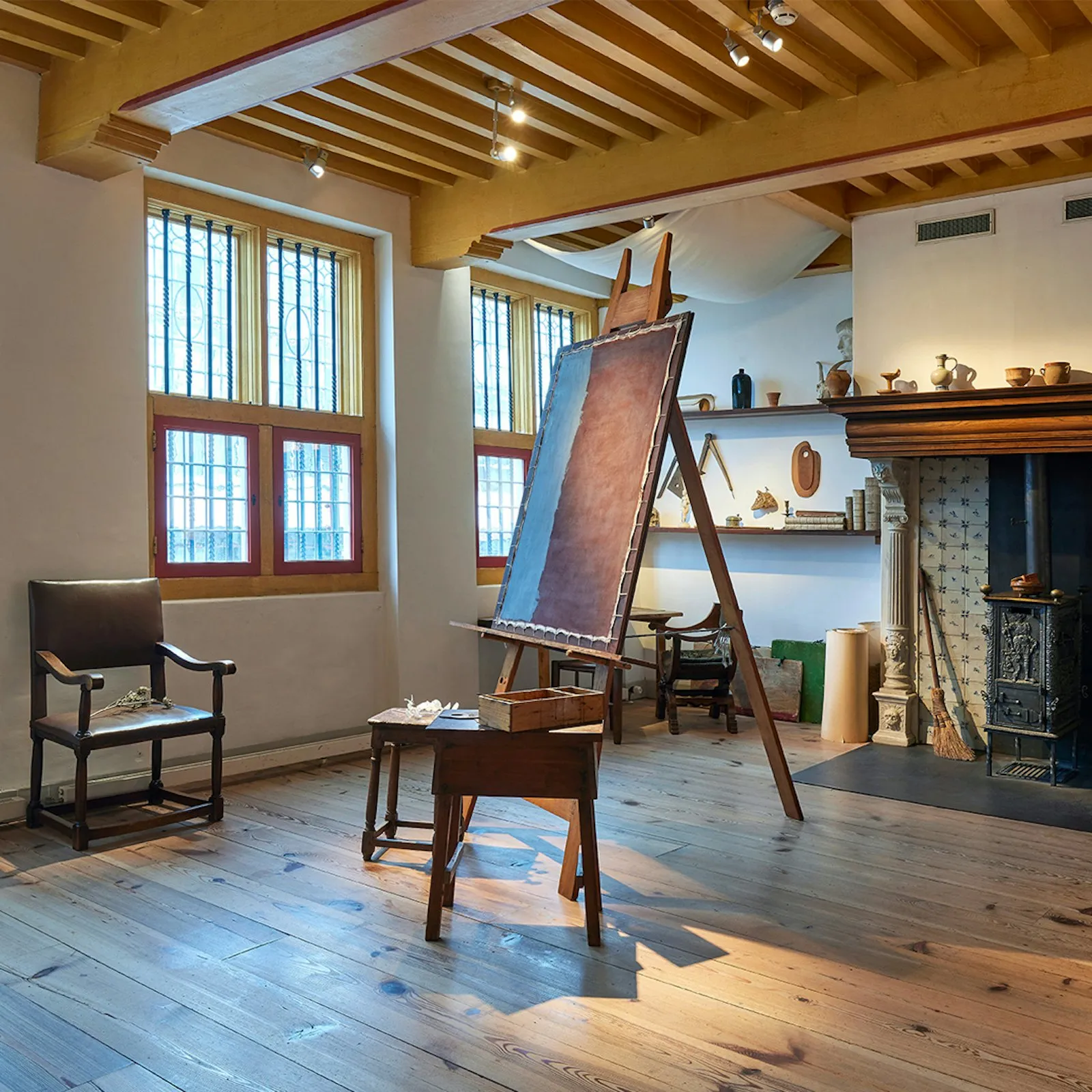
The heart of the visit. The large, light-filled studio shows where he painted and taught, with easels, pigments and tools arranged as they might have been. Look at the windows and the light, and think how important these were to his style.
Etching Demonstrations
Live demonstrations show how Rembrandt made his prints, from drawing on a copper plate to printing the final image. It is fascinating to see the process, and it explains why his etchings were so highly valued. Check the schedule on arrival.
Period Interiors
Rooms such as the entrance hall, the reception room and the bedroom are furnished in 17th-century style. The details, such as tiles, textiles and wooden panelling, give a good sense of the wealth and taste of a Golden Age household.
Print Collection
The museum holds nearly all of Rembrandt's etchings. These small, finely detailed prints show his skill with line and tone, and they include portraits, landscapes and biblical scenes. Changing displays highlight different parts of the collection.
The Kitchen
The kitchen is a small, atmospheric space with a hearth, pots and everyday objects. It reminds you that this was a family home as well as a workplace.
The Art Cabinet
Rembrandt's art cabinet, or Kunstkamer, was filled with exotic objects, from shells and animal skins to busts and weapons. It is recreated here, and it shows the curiosity and ambition of the man.
Historic Furniture
Beds, chairs, cupboards and tables show how the house was lived in. Some pieces are period originals and others are carefully made to match the inventory.
What to Expect Inside
The Visitor Route
You begin in the modern building next door, where the ticket desk and cloakroom are, and then cross into the historic house. The route climbs through the floors, from the reception rooms to the studios, and returns to the museum wing for exhibitions.
Recreated Rooms
The rooms are furnished based on the 1656 inventory. Colours, textiles and objects are chosen to match the record, so the atmosphere is very close to Rembrandt's day.
Live Demonstrations
Etching and printing demonstrations are held at set times. They are often a highlight and a great way to understand his graphic work.
Collection Highlights
The exhibition spaces show prints and drawings by Rembrandt, his teacher and his pupils. Displays change, so look for the current exhibition.
How Much Time You Need
Allow 1 to 1.5 hours. Art lovers who want to read every label and watch a demonstration may stay closer to two hours.
Visitor Information
- Address: Jodenbreestraat 4, 1011 NK Amsterdam.
- Hours: Open daily, generally from the morning to the early evening. Check the current schedule.
- Ticket prices: Typically in the mid-teens to around €20 for adults, with reduced prices for younger visitors. Prices may change.
- Accessibility: The historic house has steep stairs and narrow spaces. The modern wing has lifts and accessible areas. Contact the museum for specific needs.
- Photography: Usually allowed for personal use in much of the house, without flash. Follow the signs in each room.
- Audio guide: Available in several languages and recommended for first-time visitors.
- Lockers: Lockers or a cloakroom for coats and bags. Large bags may not be taken into the historic rooms.
Best Time to Visit
- Morning: Calmest, and the best time to enjoy the small rooms without crowds.
- Afternoon: Busier, but late in the day it can be quiet again before closing.
- Weekdays: Quieter and easier to book at short notice.
- Weekends: Busy, with timed slots filling quickly. Book ahead.
- Summer: Peak tourist season. The museum is cool inside, but book a morning slot.
- Winter: Quieter and atmospheric, with the 17th-century rooms feeling especially intimate.
How to Get to the Rembrandt House Museum
- From Amsterdam Centraal: Take tram 14 to Waterlooplein, about 10 minutes, or walk for around 20 minutes through the old centre.
- From Schiphol Airport: Take a train to Amsterdam Centraal, about 15–20 minutes, and continue by tram or metro.
- By tram: Tram 14 stops at Waterlooplein, a short walk from the museum. Check a live planner for the current network.
- By metro: Waterlooplein metro station is just a few minutes away.
- On foot: About 10 minutes from Dam Square and 15 minutes from Centraal. A pleasant walk along the canals.
- By bike: Easy and popular with locals, with bike racks nearby.
Who Is This Museum For?
Art Lovers
Essential for anyone who loves Rembrandt. The prints and the studio add a layer that the great paintings cannot.
History Enthusiasts
The house gives a vivid view of 17th-century domestic life in Amsterdam, with details taken from a real inventory.
Couples
A quiet, atmospheric visit that pairs well with a stroll through the old centre and dinner nearby.
Solo Travelers
Easy to enjoy alone, with the audio guide and a calm pace.
Cruise Passengers
A short visit that fits well into a day in port. Book a slot and allow about 1.5 hours.
Weekend Visitors
A good complement to a bigger museum. Book a morning slot to avoid the busiest times.
Local Insider Tips
- Book a morning slot to enjoy the small rooms with fewer people.
- Use the audio guide to follow Rembrandt's life as you walk.
- Check the schedule for the etching demonstration and plan your visit around it.
- Visit the Rijksmuseum the same day to see The Night Watch and compare.
- Wear comfortable shoes, as the historic staircases are steep.
- Look closely at the windows and the way light enters the studio.
- Leave large bags in the lockers before entering the historic house.
- Allow time in the exhibition wing, which often has excellent changing displays.
- Walk through Waterlooplein after your visit and look at the Stopera and the market.
- Read the inventory notes in the rooms. They show how closely the museum matches the original.
- Bring a small notebook if you enjoy sketching. The museum is a good place for it.
- Check combination tickets if you plan other museums on the same trip.
Best Photo Spots
The museum is deeply atmospheric, and the quality of the light is part of its appeal. Without flash, the soft window light gives photographs a warm, painterly feel that suits the setting.
Historic Interiors
The reception rooms, the bedroom and the kitchen are full of texture, from wooden beams and tiles to textiles. Photograph the corners where light falls across furniture, and keep an eye out for reflections in glass.
Artist Studio
The studio is the most photogenic room. Use the windows as a light source and compose shots of easels, pigments and brushes. Step back to capture the whole space and then move in for details.
Architectural Details
Look for staircases, doorways, ceiling beams and window frames. They show the construction of a 17th-century Amsterdam house. Outside, the facade on Jodenbreestraat and the surrounding streets make a good frame for a final photo.
Authentic Atmosphere
Capture the quiet moments: a visitor studying an etching, the demonstrator at the press, the soft shadows in a corridor. Keep your phone steady and be respectful of other visitors.
Choosing the Right Ticket
- Standard entry: Timed admission to the house and exhibitions. The right choice for most visitors.
- Audio guide: A helpful addition for first-time visitors who want context as they move through the rooms.
- Combination tickets: Bundles with another Amsterdam attraction or a canal cruise can simplify planning. Compare the listings above.
- Museum passes: The Museumkaart and the I amsterdam City Card can save money if you visit several museums. You may still need to reserve a time slot.
- Special exhibitions: The museum runs changing exhibitions, which are normally included in admission. Check what is on during your visit.
Compare the options in the ticket section above before you pay. Each listing shows what is included.
Nearby Attractions
- Rijksmuseum: Home to The Night Watch and many other Rembrandts.
- Van Gogh Museum: A natural pairing for a day of art.
- Anne Frank House: A poignant sight a short tram ride away. Book far in advance.
- Jewish Cultural Quarter: A group of museums and memorials just around the corner, covering Jewish history in Amsterdam.
- ARTIS Royal Zoo: A short tram ride away, ideal for families.
- Dam Square: The heart of Amsterdam, within walking distance.
- Canal cruises: Departures are close by.
For more ideas, browse our Amsterdam museums guide, the Heineken Experience, the A'DAM Lookout, our things to do in Amsterdam and the Amsterdam travel guide.
Suggested Itineraries
Half-Day
10:00 Rembrandt House Museum, 11:30 coffee at Waterlooplein, 12:30 lunch in the Jewish quarter.
Art Lovers Day
9:00 Rembrandt House Museum, 11:30 lunch, 13:00 Rijksmuseum for The Night Watch, 16:00 Van Gogh Museum or a canal walk.
Historic Amsterdam Day
9:30 Rembrandt House Museum, 11:30 Jewish Cultural Quarter, 14:00 Dam Square and the Royal Palace, 16:00 canal cruise.
Weekend Visitor
Saturday: Rembrandt House in the morning, canal cruise in the afternoon. Sunday: Rijksmuseum and a market.
First-Time Visitor
Morning at the Rembrandt House, afternoon in the old centre, evening canal walk. See our 3-day Amsterdam plan for more.
Top 5 Reasons Visitors Love Rembrandthuis
- An authentic home. It is the real house where Rembrandt lived and worked.
- A real artist studio. Stand in the space where he painted and taught.
- Historic atmosphere. The rooms feel remarkably close to the 17th century.
- Demonstrations. Live etching shows bring his craft to life.
- A strong connection with Rembrandt. You come away with a sense of the person behind the paintings.
Rembrandt House Museum FAQ
Is Rembrandthuis worth visiting?
Yes, particularly if you are interested in Rembrandt or Golden Age Amsterdam. It is a compact, personal museum in the house where he lived and worked, and it adds context that large art museums cannot offer. It is quieter and quicker than the big museums.
How long does the Rembrandt House Museum take?
Plan 1 to 1.5 hours. Add time if you watch an etching demonstration, use the audio guide fully or visit a special exhibition.
Can you see original works at the Rembrandt House Museum?
Yes. The museum holds a large collection of Rembrandt's etchings and drawings, plus works by his teacher and pupils. The famous paintings, such as The Night Watch, are in the Rijksmuseum, with the museum offering the context of his daily life.
Did Rembrandt really live here?
Yes. He bought the house in 1639 and lived and worked there until 1658, when financial problems forced him to sell. It is the only surviving house in the Netherlands where he lived.
What is the best time to visit the Rembrandt House Museum?
Weekday mornings are usually quietest. Late afternoon can also be calm, and weekends and school holidays are the busiest.
Is photography allowed?
Photography is usually permitted in much of the historic house for personal use, without flash, though rules can differ in the exhibition spaces. Follow the signs and any guidance from staff.
Is the Rembrandt House Museum accessible?
The original 17th-century house has steep stairs and narrow spaces, which limit access in places. A newer wing offers lifts and accessible areas. Contact the museum in advance to plan your visit.
Can children visit the Rembrandt House Museum?
Yes. The museum is suitable for school-age children, especially with the audio guide and the etching demonstrations. Younger children may find the quiet rooms less engaging.
What is included in a ticket?
A standard ticket includes admission to the historic house, the museum's permanent displays and current exhibitions, normally with an audio guide available. Check your booking page for the exact inclusions.
How much are Rembrandt House Museum tickets?
Adult tickets are typically in the mid-teens to around €20, with reduced prices for young visitors. Prices vary by date, so check the current price when you book.
Where is the Rembrandt House Museum?
It is at Jodenbreestraat 4, 1011 NK Amsterdam, in the historic Jewish quarter, close to Waterlooplein, the Stopera and the old centre.
Can I buy tickets at the door?
Often, but not reliably. The museum uses timed entry, and popular slots can sell out. Booking online is the safest option.
Are there etching demonstrations?
Yes. The museum offers regular demonstrations of etching and printing techniques. Check the schedule when you arrive, as times can vary.
Is there an audio guide?
Yes. An audio guide helps you follow Rembrandt's life through the rooms and is available in several languages.
Are there lockers and a cloakroom?
Lockers or a cloakroom are normally provided for coats and bags. Large bags may not be allowed in the historic rooms.
Is there a café?
There is a small café in the museum, and many cafés and restaurants are within a few minutes' walk around Waterlooplein and the Jewish quarter.
Can I visit on a cruise day or a short layover?
Yes. The museum is close to the centre and easy to reach by tram. Book a timed slot, allow about 1.5 hours and keep a buffer for the return trip.
Can I combine it with other museums?
Yes. It pairs well with the Rijksmuseum for the paintings, and with the Jewish Cultural Quarter nearby. Compare combination tickets and museum passes before you buy.
Which Rembrandt paintings can I see in Amsterdam?
The Rijksmuseum holds The Night Watch and many other works, and the Rembrandt House Museum shows his etchings, drawings and setting. Together they give a full picture.
Is the Rembrandt House Museum open every day?
Normally yes, apart from a few holidays. Opening hours can vary, so check the current schedule before you visit.
Are the rooms original?
The house is the original building, but the interiors have been restored and furnished based on a 1656 inventory of his possessions. Some pieces are period items and others are reconstructions.
Is it good on a rainy day?
Yes. It is a short, fully indoor visit in the centre, so it suits a wet afternoon.
Free Amsterdam Insider Guide
Get our free Amsterdam guide with museum tips, hidden spots and seasonal events straight to your inbox.
Free Weekly Newsletter
Stay in the Loop on Amsterdam
Weekly events updates, travel tips, festival announcements, seasonal guides and day trip inspiration — delivered straight to your inbox.
- ✓ Weekly events updates
- ✓ Amsterdam travel tips
- ✓ Festival announcements
- ✓ Seasonal guides
- ✓ Day trip inspiration
🔒 Spam-beschermd. Uitschrijven altijd mogelijk.
Final Verdict
The Rembrandt House Museum is a small, atmospheric and deeply personal museum. It does not replace the great paintings in the Rijksmuseum, but it explains the man behind them in a way no other place can. It is easy to fit into a busy day, and we recommend booking a timed ticket in advance.
Who should visit: art lovers, history enthusiasts, couples, solo travellers and anyone curious about Rembrandt and Golden Age Amsterdam.
Who may skip: visitors with very little time who would rather see the big masterpieces at the Rijksmuseum, and travellers with mobility needs, who should check access first.
Overall rating: 8.8 / 10
Recommendation: a rewarding visit for most art and history lovers, best booked ahead and paired with the Rijksmuseum.