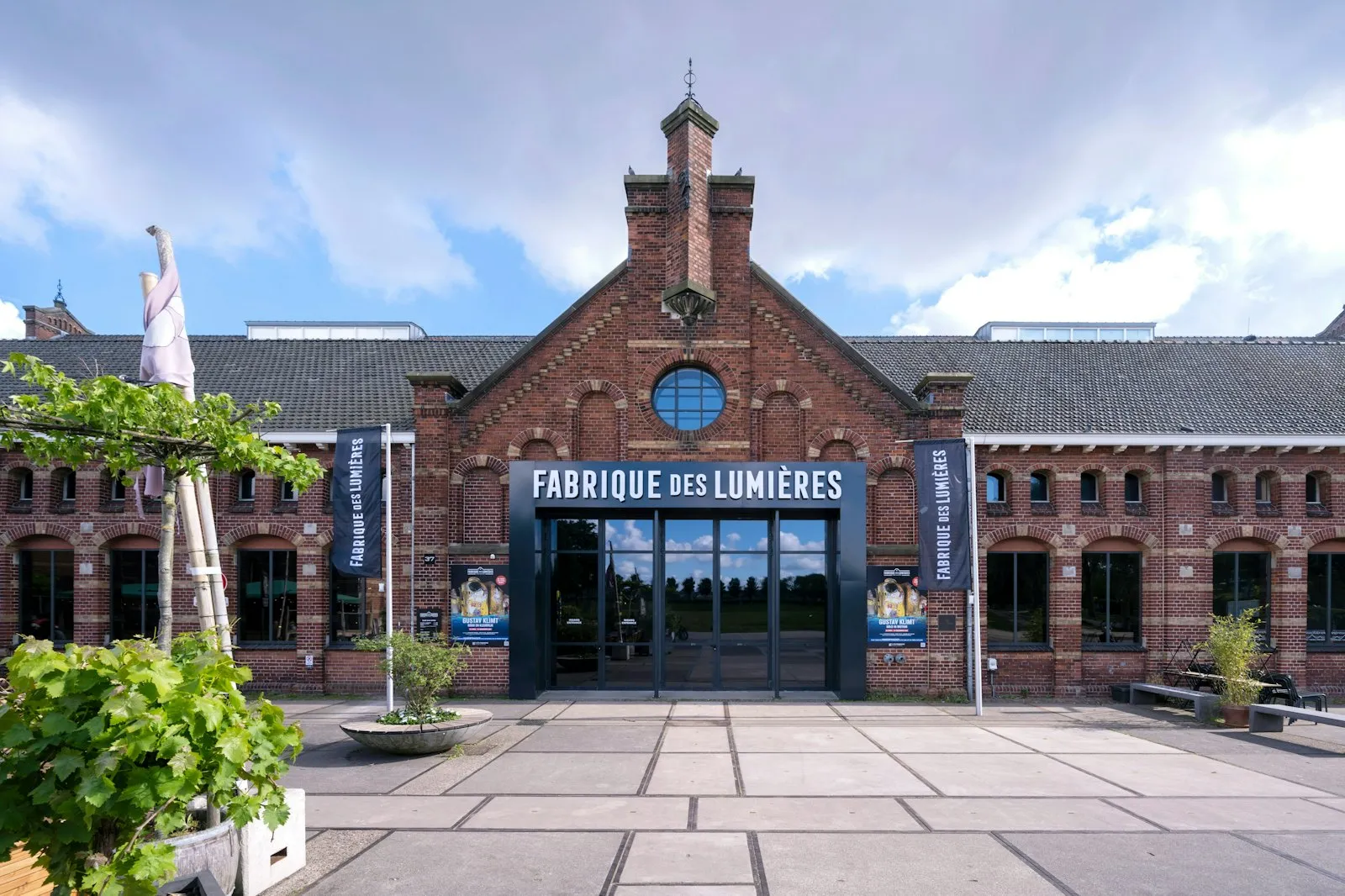
Fabrique des Lumières Amsterdam: The Complete Visitor Guide
Tickets, current exhibitions, photo tips and practical advice for Amsterdam's immersive digital art centre in a former gasworks.
Address
Pazzanistraat 37, 1014 DB Amsterdam
Opening hours
Mon–Wed & Sun 9:30–18:00, Thu–Sat 9:30–19:30 (each exhibition has its own time slots)
Ticket price
Adults €18, youth 5–17 €14, family €52
Best for
Couples, families, art lovers, photographers
Duration
About 45–60 minutes
Book Fabrique des Lumières Tickets
Entry is by timed ticket. Choose your date and time, then compare standard admission with other options. Each listing shows which exhibition and time slot it covers, so check it before you book.
Important Before You Visit
- Fabrique des Lumières is not a traditional museum. It is an immersive digital art centre.
- Original paintings are not displayed. You will not see canvases on walls, and the works of the artists appear as digital images.
- Artworks are projected onto walls, floors and ceilings. Powerful projectors and a sound system turn the whole space into a moving artwork.
- Visitors walk freely through the exhibition. There is no fixed route and no fixed seating. You can walk, sit, stand and stay for more than one loop.
- Photography is generally welcomed. The visuals are made for it, but avoid flash and respect other visitors.
- The experience is immersive and sensory. Expect moving images, music and low light.
- It is suitable for most visitors. Families, couples and groups all enjoy it. Visitors who are sensitive to moving images may prefer to sit near the edge.
Why Book in Advance
Fabrique des Lumières is one of the most popular indoor attractions in Amsterdam, and admission is limited and timed. Weekends and school holidays are the busiest, and each exhibition has its own time slots, so the one you want may only run at certain times of day. Booking online lets you choose the experience and the hour that suit you, and makes planning your day much easier.
What is Fabrique des Lumières, and is it worth visiting?
Fabrique des Lumières is an immersive digital art centre in a former Amsterdam gasworks, where famous artworks are projected onto walls and floors with music. It is worth visiting for its stunning visuals and relaxed atmosphere, especially for families, couples and photographers.
Why Visit Fabrique des Lumières?
Fabrique des Lumières offers something very different from a traditional gallery. Instead of standing in front of a framed painting, you step into a vast hall where the brushstrokes of Vermeer or Van Gogh flow across the walls and floor around you. Music accompanies the images, and the artworks seem to move and change, so you feel as if you are walking through a painting.
It is a unique visual experience. The scale is part of the magic: giant projections, reflections on the floor and soundtracks that match the mood of each work. The venue is big enough that you can wander, find your own viewpoint and see the same scene from different angles. Many visitors say they notice details in famous works that they would miss in a museum.
It is also a relaxed, family-friendly attraction. There are no rules about how to look at the art, children can move around, and the experience is short, about the length of a film. It is a perfect rainy-day option, with a calm and dreamlike atmosphere that suits any weather.
And it is one of the most photogenic experiences in Amsterdam. The mix of colour, motion and architecture creates images that are made for sharing, and the setting in a former industrial building adds a striking contrast with the soft, glowing visuals.
History of Fabrique des Lumières
The Former Gasworks
The building has a fascinating past. The Westergasfabriek was built in the early 1880s as a coal-fired gasworks to produce gas for Amsterdam's street lighting. It was completed in 1885, a four-hectare complex of gasholders, coal stores and a water tower, designed by the engineer Julius Pazzani and the architect Isaac Gosschalk in the Dutch Neo-Renaissance style, with red and yellow brick, symmetry and decorative details.
It became the largest coal-fired gasworks in the country, and in 1898 it passed into the ownership of the city of Amsterdam. The complex was extended several times, with a huge gasholder added in 1902. But in the 1960s the Netherlands discovered large reserves of natural gas, and coal-gas production came to an end. The works closed in 1967, and some buildings were demolished in the following years.
From Industrial Site to Cultural Area
After decades as storage and workshops, the area was redeveloped, beginning with a city plan in the early 1980s. Because the land was heavily polluted, it was cleaned and turned into a park, and the surviving buildings were repurposed for culture and creative businesses. Today the Westergasfabriek is part of Westerpark, with cafés, festivals, events and studios. It is one of the most atmospheric cultural spaces in the city.
The Digital Art Concept
Fabrique des Lumières is run by Culturespaces, a French company that specialises in bringing heritage sites to new audiences. The concept is to use powerful digital projectors and sound to transform large historic spaces into immersive art environments. It reuses industrial buildings and gives them a second life, rather than building new galleries.
Origins of Immersive Exhibitions
Culturespaces developed the idea at sites in France. Its early experiment took place in a former limestone quarry in Provence, which became a projection space in the 1970s. Later it opened an arts centre in a former foundry in Paris and a space in a former submarine base in Bordeaux. These projects showed that visitors loved to experience art in a large, atmospheric setting, and they inspired more centres.
Arrival in Amsterdam
The Amsterdam centre uses the Zuiveringshal, a former purification hall on the Westergasfabriek site, and it offers two spaces, the Hall and the Studio. The choice of a historic industrial building ties the project to the area's history, while the programme brings in artists that suit Dutch audiences, from the Dutch Masters to international names. The centre has been recognised in the Netherlands as a remarkable venue.
Cultural Importance
Fabrique des Lumières has become an important part of Amsterdam's cultural landscape. It makes famous art accessible to people who might not visit a museum, it gives the former gasworks a new role, and it offers a new way to experience familiar works. It does not replace seeing original art, but it complements it, and it is a popular first step into art for many younger visitors.
What Is Immersive Digital Art?
Digital Projection Technology
Immersive digital art uses many powerful projectors to cover large surfaces with images. In Fabrique des Lumières, the images fall on walls, floors, columns and ceilings, so the artwork surrounds you. Software adapts each image to the shape of the space, a technique often called projection mapping.
Multi-Sensory Storytelling
The show is more than a slideshow. Images follow a story, building from one theme to the next, and the music is chosen to match. Sound, colour, light and movement combine, so you feel the mood of each work as well as see it.
Moving Artworks
Famous paintings are animated in subtle ways. Brushstrokes seem to appear, colours flow, details zoom in and out, and elements of a painting may drift across the space. It is a way of exploring a work from the inside, noticing textures and details that are hard to see on a canvas.
Music and Visual Effects
Music is an essential part of the experience. It sets the rhythm of the show and shapes the emotion. Visual effects, such as shimmering water, falling petals or swirling skies, add to the drama and give the artworks a sense of life.
Why Immersive Exhibitions Became Popular
Immersive exhibitions have grown in popularity because they are easy to enjoy. You do not need to know anything about art, you can move around freely, and the experience is lively and photogenic. They suit families and groups, and they offer a new way to engage with artists of the past. For many visitors, they are a gateway to visiting real museums.
Top Highlights
The Massive Projection Hall
The main hall is vast, with high walls and a large floor. The scale makes the projections feel monumental, and you can wander around to find the best view.
A 360-Degree Art Experience
Images cover every direction, so you are inside the artwork. Turning around reveals new scenes, and sitting at different spots changes the experience.
Famous Artists Brought to Life
The programme features renowned artists. According to the venue's current programme, you can see Dutch Masters from Vermeer to Van Gogh, The Renaissance Masters (Da Vinci, Raphael and Michelangelo) and an exhibition by the photographer Jimmy Nelson called Mirrors of Humanity. Past shows have included Monet, Dalí and Gaudí. Programmes rotate, so check what is on for your date.
Floor-to-Ceiling Visuals
The images cover the floor as well as the walls and ceiling, which creates reflections and a sense of floating. Stand in the middle of the hall for the full effect.
Music Integration
The soundtrack is composed and chosen to match the artworks. It transforms a sequence of images into an emotional journey.
Special Temporary Exhibitions
The centre runs different exhibitions, sometimes in separate spaces, such as the Hall and the Studio. Check the schedule, because each exhibition has its own times.
An Interactive Atmosphere
Although the show is not interactive in the sense of buttons, the relaxed, open layout lets you move, sit, lie back and share the experience with others.
What to Expect Inside
Arrival
You arrive at Pazzanistraat 37 in Westerpark, scan your ticket and enter the lobby. Check which exhibition and time slot your ticket covers, because each experience has its own times.
The Exhibition Flow
You walk straight into the space, where the show is already running on a loop. There is no fixed route, so you decide where to stand and when to move.
The Projection Experience
Images flow across the walls and floors, changing with the music. Take time to look in different directions and from different spots.
The Music Experience
The soundtrack plays throughout, and it is best enjoyed by pausing and listening, especially at the moments when the images and music build together.
How Much Time You Need
A single exhibition lasts about 35 minutes as a loop. Most visitors stay 45 to 60 minutes, and some stay for a second loop.
Visitor Information
- Address: Pazzanistraat 37, 1014 DB Amsterdam.
- Opening hours: Monday to Wednesday and Sunday 9:30–18:00, Thursday to Saturday 9:30–19:30. Each experience has different time slots, and the final entry is one hour before closing. From 16 October 2026 to 3 January 2027, the daily schedule is Dutch Masters 9:30–10:30, The Renaissance Masters 11:00–14:30 and Jimmy Nelson from 15:00 until closing. Some dates have shorter hours, so check before you go.
- Ticket prices: Adults €18, students €14, youth aged 5–17 €14, family rate (two adults and two young people) €52, children under 5 free. Prices can change.
- Accessibility: The venue has an accessibility page and offers step-free routes. Contact them in advance for specific needs.
- Photography: Generally welcomed for personal use, without flash.
- Lockers: Check the facilities on arrival, and travel light if possible.
- Gift shop: A shop with art-related gifts and souvenirs.
- Café: There are cafés and restaurants in the surrounding Westergasfabriek area, a short walk away.
Best Time to Visit
- Morning: Calmest, with more room to move and take photographs.
- Afternoon: Busier, especially at weekends and after lunch.
- Weekdays: Quieter and easier to book at short notice.
- Weekends: Busy. Book a morning slot.
- Rainy days: A favourite indoor option, so book ahead.
- School holidays: The busiest times. Expect more families and choose an early slot.
How to Get to Fabrique des Lumières
- From Amsterdam Centraal: Take bus 21 toward Geuzenveld and get off at Van Hallstraat. From there it is a five-minute walk.
- From Schiphol Airport: Take a train to Amsterdam Centraal, about 15–20 minutes, then continue by bus 21.
- By tram: Tram 5 from the museum area stops at Van Limburg Stirumstraat or Van Hallstraat, five minutes from the venue. Tram 3 stops at Frederik Hendrikplantsoen, an 18-minute walk.
- By bus: Bus 21 is the simplest option from the centre.
- By bike: The park setting makes cycling easy, and there is bike parking nearby.
- Walking directions: Follow the signs for Westergasfabriek and Westerpark. Parking is also available at the nearby car park, about a 10-minute walk.
Who Is This Experience For?
Art Lovers
A fresh way to see familiar artists, especially when you pair it with a visit to a real museum.
Families
Children under 5 enter free, a family rate applies, and the open space suits restless children.
Couples
A romantic and calming experience, particularly in the afternoon or early evening.
Photographers
An endless supply of colour, light and motion. See the photo section for tips.
Teenagers
Teenagers love the visuals and the chance to take creative photos and videos.
Weekend Visitors
A relaxed and memorable stop. Book a slot in advance.
Who Should Probably Skip This?
Fabrique des Lumières is wonderful for the right audience, but it may disappoint some visitors. Consider skipping it if you fit one of these descriptions.
- Visitors expecting a traditional museum: There are no galleries, no framed paintings and no quiet corners of contemplation. It is an immersive show.
- Visitors who want original artworks: Everything you see is a projection. If your priority is original paintings, visit the Rijksmuseum or the Van Gogh Museum.
- Visitors looking for detailed art history: The experience is visual and emotional, with limited explanation of context.
- People who dislike projection-heavy experiences: If moving images, music and low light are uncomfortable for you, this may not be relaxing.
Local Insider Tips
- Check which exhibition runs at your time slot before you book.
- Book online for the exhibition you want to see, as the three experiences run at different hours.
- Arrive about 10 minutes before your slot.
- Wear comfortable shoes, as you may walk and stand for most of the visit.
- Take a few minutes to sit on the floor or a bench and watch, so you can see the whole room.
- Stay for a second loop if you can, because you will notice new details.
- Charge your phone and clear some space for photos and videos.
- Walk to the edges and the centre, since the experience changes with your position.
- Combine your visit with a stroll in Westerpark and a coffee in the Westergasfabriek.
- Pair it with a real museum on another day to see the originals.
- Bring a light layer, as large halls can be cool.
- Check the I amsterdam City Card rules if you have one, as it can give free entry at the ticket desk.
Best Photo Spots and Photography Tips
This is one of the most photogenic attractions in Amsterdam. The projection mapping, moving artworks and 360-degree environment give you endless material for photos and videos, and the experience is designed with social media in mind.
The Projection Hall
The main hall is the star. Stand near the middle for symmetrical shots, or at the sides to include the architecture of the former gasworks. Wide-angle shots show the scale, while close-ups capture details.
Reflective Floor Effects
Projections on the floor create reflections and a feeling of walking on a painting. Crouch low for dramatic images that blend the floor and the wall.
The Entrance Area
The entrance and lobby are well suited to a souvenir photo of you and your group before you go in, with the signage and the industrial setting.
The Building Exterior
The red-brick buildings of the old gasworks, with their historic details, make a lovely backdrop. Take a photo outside, before or after your visit, in daylight.
Best Times for Photography
Choose a quiet weekday slot for the least crowded images. Early slots are best for clear shots without other visitors.
Photography Tips
- Turn off the flash, because it washes out the projections.
- Use night mode on your phone and hold it steady for a second or two.
- Tap on the brightest part of the picture to avoid overexposure.
- Try short videos and slow pans to capture the movement.
- Include people as silhouettes to give a sense of scale.
- Take photos of the fine details, such as brushstroke textures.
- Put your phone away for a few minutes and enjoy the moment.
Choosing the Right Ticket
- Standard entry: A timed ticket for the exhibition of your choice. The right choice for most visitors. Adults pay €18 at the venue's published rate.
- Family visits: A family rate covers two adults and two young people aged 5 to 17, and children under 5 are free.
- Combination tickets: The venue offers combination tickets with other attractions. Compare the listings above and check what is included.
- Temporary exhibition access: Each exhibition has its own time slots, so make sure your ticket matches the experience you want.
- Premium options: Some listings may include extras, such as priority entry or special packages.
Compare the options in the ticket section above before you pay. Each listing shows what is included.
Nearby Attractions
- Westerpark: A large, relaxed park next door, ideal for a stroll or a picnic.
- Westergas: The former gasworks complex, now home to cafés, restaurants, studios and events.
- Anne Frank House: A short ride away, a poignant visit that must be booked in advance.
- Canal cruises: A relaxing way to see the city from the water.
- Rijksmuseum and Van Gogh Museum: See the original masterpieces that you encounter here in projection.
- A'DAM Lookout: A panoramic view on the other side of the IJ.
For more ideas, see THIS IS HOLLAND, the Moco Museum for modern art, the Amsterdam Light Festival in winter, our Amsterdam museums guide, our things to do in Amsterdam and the Amsterdam travel guide.
Suggested Itineraries
Fabrique + Westerpark
10:30 Fabrique des Lumières, 12:00 lunch at a Westergas café, 13:30 stroll through Westerpark.
Rainy Day Amsterdam
10:00 Fabrique des Lumières, 12:30 lunch, 14:30 museum in the centre, such as the Rijksmuseum, 17:00 coffee and cake.
Art Lovers Day
Morning at Fabrique des Lumières for the immersive version of the Dutch Masters, afternoon at the Rijksmuseum or Van Gogh Museum to see the originals.
Weekend Visitor
Saturday: Fabrique des Lumières in the morning, canal cruise in the afternoon. Sunday: Westerpark, a market and an evening walk.
First-Time Visitor
Morning in the old centre, an afternoon at Fabrique des Lumières and an evening canal walk. See our 3-day Amsterdam plan for more.
Top 5 Reasons Visitors Love Fabrique des Lumières
- Immersive digital art. Step inside famous artworks that move and change around you.
- Incredible visuals. Giant projections, rich colour and music create a dreamlike atmosphere.
- Great photography. Every corner is made for photos and videos.
- Family friendly. Relaxed, short and open, with a family rate and free entry for under-fives.
- A unique Amsterdam experience. A historic gasworks reborn as a stage for light and music.
Fabrique des Lumières FAQ
Is Fabrique des Lumières worth visiting?
Yes, for most visitors. It is a beautiful, immersive way to experience art, with huge projections, music and a relaxed pace. It is especially good for families, couples, photographers and rainy days. It is less suited to visitors who want to see original paintings.
Are there original paintings at Fabrique des Lumières?
No. The artworks are digital images projected onto walls, floors and ceilings. The experience is built from reproductions of famous works, brought to life with movement and music, and it is not a traditional museum.
How long does it take?
Each exhibition lasts roughly 35 minutes as a looped show, and most visitors stay around 45 to 60 minutes. You can stay for more than one loop, walk around and view the artworks from different spots.
Can children visit Fabrique des Lumières?
Yes. Children under 5 enter free, and there is a family rate for two adults and two young people aged 5 to 17. The visuals and music are engaging for children, and the open space lets them move around.
Is photography allowed?
Photography is generally welcomed for personal use, and the projections are made for it. Avoid flash, and be considerate of other visitors. Check the venue's current rules on arrival.
Is Fabrique des Lumières accessible?
The venue has an accessibility page and is generally designed to be accessible, with a flat floor in the main hall. Contact the venue in advance for specific needs, such as wheelchair access or seating.
What is the best time to visit?
Weekday mornings and early afternoons are usually calmest. Weekends, school holidays and rainy afternoons are the busiest. Check which exhibition runs at which time slot, as each experience has its own hours.
How much are tickets?
According to the venue's published rates, adult tickets are €18, students and young people aged 5 to 17 pay €14, and a family rate of €52 covers two adults and two young people. Children under 5 are free. Prices can change, so check when you book.
What artists are featured?
Exhibitions rotate. At the time of writing, the programme includes Dutch Masters from Vermeer to Van Gogh, The Renaissance Masters (Da Vinci, Raphael and Michelangelo) and a Jimmy Nelson photography exhibition. Past exhibitions have featured artists such as Monet, Dalí and Gaudí.
What is immersive art?
Immersive art surrounds you with images and sound rather than showing them in frames. Large projections cover the walls and floors, so you walk through the artwork and experience it from the inside.
Where is Fabrique des Lumières?
It is at Pazzanistraat 37, 1014 DB Amsterdam, in the former Westergasfabriek gasworks area, next to Westerpark.
How do I get there by public transport?
From Amsterdam Centraal, take bus 21 toward Geuzenveld to Van Hallstraat, then walk about five minutes. Tram 5 from the museum area stops at Van Limburg Stirumstraat or Van Hallstraat, also about five minutes' walk.
Can I buy tickets at the door?
Sometimes, but admission is timed and popular times can sell out. Booking online is the safest option.
Is it good on a rainy day?
Yes. It is fully indoors, calm and atmospheric, and one of the best wet-weather activities in Amsterdam.
Do the exhibitions have different opening hours?
Yes. Each experience has its own time slots. For example, during the winter period one exhibition may run in the morning, another around midday, and a third in the afternoon. Check the schedule for your date.
What was this building before?
The venue is in the former Westergasfabriek, a coal-fired gasworks built in the 1880s to produce gas for Amsterdam's street lighting. It closed in 1967 and was later transformed into a cultural area.
Is there a gift shop?
Yes. The venue has a gift shop with art-related gifts, books and souvenirs.
Can I use the I amsterdam City Card?
The venue lists free entry with the I amsterdam City Card, available at the ticket desk on site. Check the current conditions before you go.
Are there combination tickets?
The venue offers combination tickets with other attractions. Compare the listings in the ticket section above and check what is included.
Can I visit on a cruise day or short layover?
Yes, with planning. Book a timed ticket, allow about two hours including travel, and keep a buffer for returning to the port or airport.
What else is nearby?
Westerpark and the Westergas complex are next door, with cafés and events. The Jordaan and the Anne Frank House are a short ride away.
Do I have to stay for the whole show?
No. You can walk in and out of the space as you like and stay for more than one loop. There is no fixed seating, so you can move around to find your favourite view.
Is there seating?
Yes, there are places to sit and watch, and some visitors choose to sit on the floor or on benches. Visitors who need to sit should ask the staff.
Free Amsterdam Insider Guide
Get our free Amsterdam guide with rainy-day tips, hidden spots and seasonal events straight to your inbox.
Free Weekly Newsletter
Stay in the Loop on Amsterdam
Weekly events updates, travel tips, festival announcements, seasonal guides and day trip inspiration — delivered straight to your inbox.
- ✓ Weekly events updates
- ✓ Amsterdam travel tips
- ✓ Festival announcements
- ✓ Seasonal guides
- ✓ Day trip inspiration
🔒 Spam-beschermd. Uitschrijven altijd mogelijk.
Final Verdict
Fabrique des Lumières is one of the most unusual and beautiful indoor attractions in Amsterdam. It is not a traditional museum and does not show original paintings, but it turns famous art into a moving, musical environment inside a handsome former gasworks. It is relaxed, photogenic and a reliable choice on a rainy day. We recommend booking a timed ticket for the exhibition you want to see.
Who should visit: families, couples, photographers, teenagers and anyone who enjoys a visual, sensory experience.
Who may skip: visitors who want original paintings or detailed art history, and those who dislike projection-heavy experiences. They may prefer the Rijksmuseum.
Overall rating: 8.8 / 10
Recommendation: a beautiful, easy and memorable experience, best booked ahead and combined with a stroll in Westerpark.